
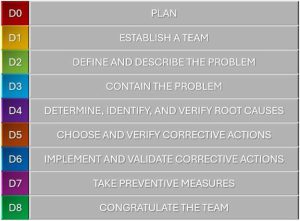
This image represents the 8D Problem-Solving Methodology, a structured and widely used approach for identifying, correcting, and preventing problems in processes, products, or systems. Each step (D0–D8) guides teams through a systematic path to ensure issues are fully understood and permanently resolved.
D0 – Plan:
This is the preparation stage where the need for the 8D process is identified. The team gathers initial information, defines the scope, and prepares resources required to tackle the problem.
D1 – Establish a Team:
A capable cross-functional team is formed. Members bring diverse skills, knowledge, and authority to analyze and resolve the issue effectively.
D2 – Define and Describe the Problem:
The problem is clearly defined using specific, measurable details (who, what, when, where, how many). A well-defined problem reduces confusion and directs the team’s focus.
D3 – Contain the Problem:
Temporary actions are taken to stop the issue from spreading or causing further damage until a permanent solution is identified. This step protects customers and processes.
D4 – Identify and Verify Root Causes:
The team investigates to find the true cause behind the problem, often using tools like the 5 Whys or Fishbone Diagram. The root cause is verified with evidence.
D5 – Choose and Verify Corrective Actions:
Permanent corrective actions (PCAs) are selected and evaluated to ensure they will eliminate the identified root cause.
D6 – Implement and Validate Corrective Actions:
The chosen corrective actions are applied, monitored, and verified to confirm their effectiveness in real-world use.
D7 – Take Preventive Measures:
Actions are taken to prevent the same or similar problems in the future. This may include updating procedures, training, or system improvements.
D8 – Congratulate the Team:
The team’s successful efforts are acknowledged. This motivates members and reinforces a culture of problem-solving.
Overall, the 8D process ensures disciplined problem resolution, long-term prevention, and continuous improvement.